MOTORHOME CLASSIFICATION: HOW IT WORKS IN THE US, IN EUROPE, AND HERE IN RUSSIA
If you try to sort out what separates a Class B from a kastenwagen, an alcove from a Super C, or a "pritsep-dacha" from a caravan, you quickly discover that there's no common language for this whole zoo. America has its own letters and terms, Europe has its own, and in Russia neither set has really taken hold.
When you open the website of a German or French rental company, you see a tidy list in front of you: "alcove, semi-integrated, integrated, kastenwagen." On an American site — "Class A, B, C, Super C, fifth-wheel, travel trailer." On a Russian one — it's hit or miss: somewhere it's "avtodom," somewhere "house on wheels," somewhere "kemper," and often all three words on the same page mean different things. It's not laziness — we simply never developed either an official GOST standard for the types or a marketing tradition that would have locked them in. So below is a short guide to the foreign systems and a look at how it all gets tangled up here.
THE AMERICAN SYSTEM: LETTERS FROM THE RVIA
In the US, classification is shaped de facto by the RVIA — the RV Industry Association, the trade body of recreational vehicle manufacturers. Legally, the letter categories (Class A/B/C) are not law but a marketing convention of the industry: a common language so that dealer, insurer, and buyer understand each other. All self-propelled motorhomes are split there into three (and a half) classes by what chassis they're built on and what the "nose" looks like.
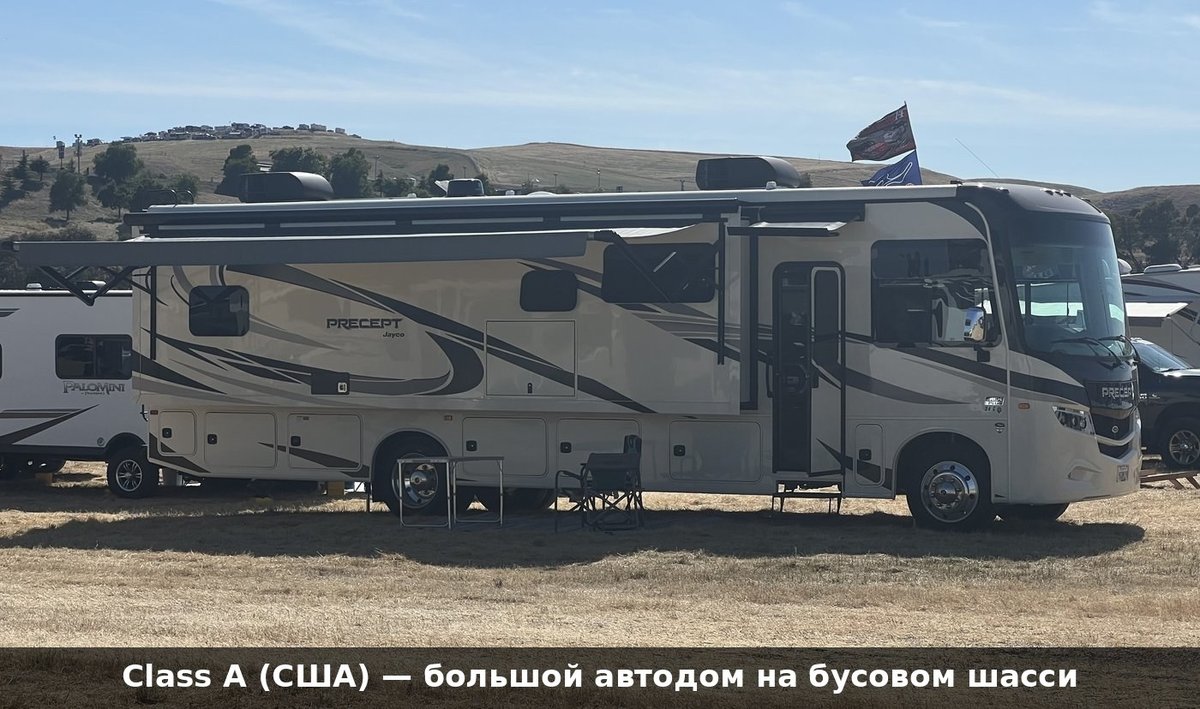
Class A — the largest, on a bus-style chassis. This is a motorhome the size of a tour bus: a dedicated motorhome chassis (Spartan, Freightliner) or a Ford F-53, sometimes a real bus frame. Length is usually 8–14 meters, price — from 150 thousand dollars for a gas-powered model to a million for a luxury-class diesel liner. The front has a flat face with a panoramic windshield. Inside — a full apartment for 4–8 people. Brands: Tiffin, Newmar, Winnebago, Thor.
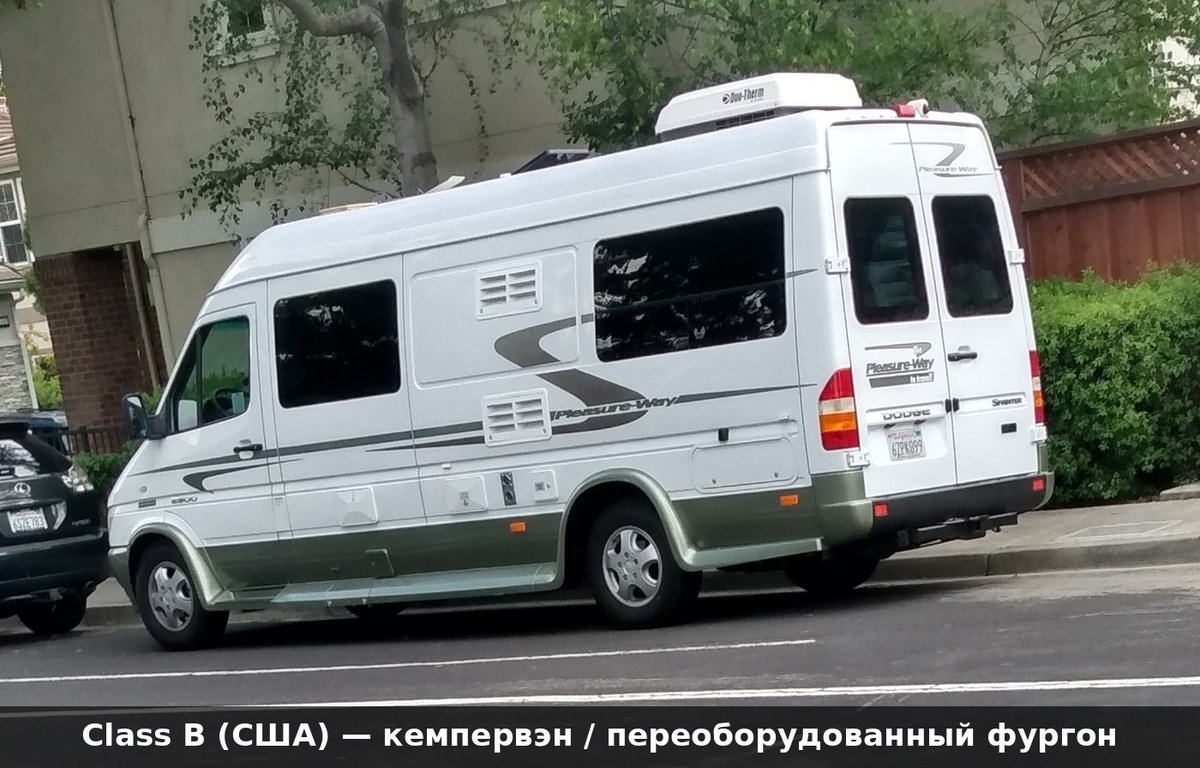
Class B — a converted all-metal van: Mercedes Sprinter, Ford Transit, RAM ProMaster. The body stays "factory" (sometimes with a raised roof or a pop-top), and the living area inside is compact. Length 5–7 meters, usually two sleeping berths. This is the most "urban" format: it's convenient for daily driving and parking in ordinary spots. Conceptually, it's the direct American counterpart of the European kastenwagen.
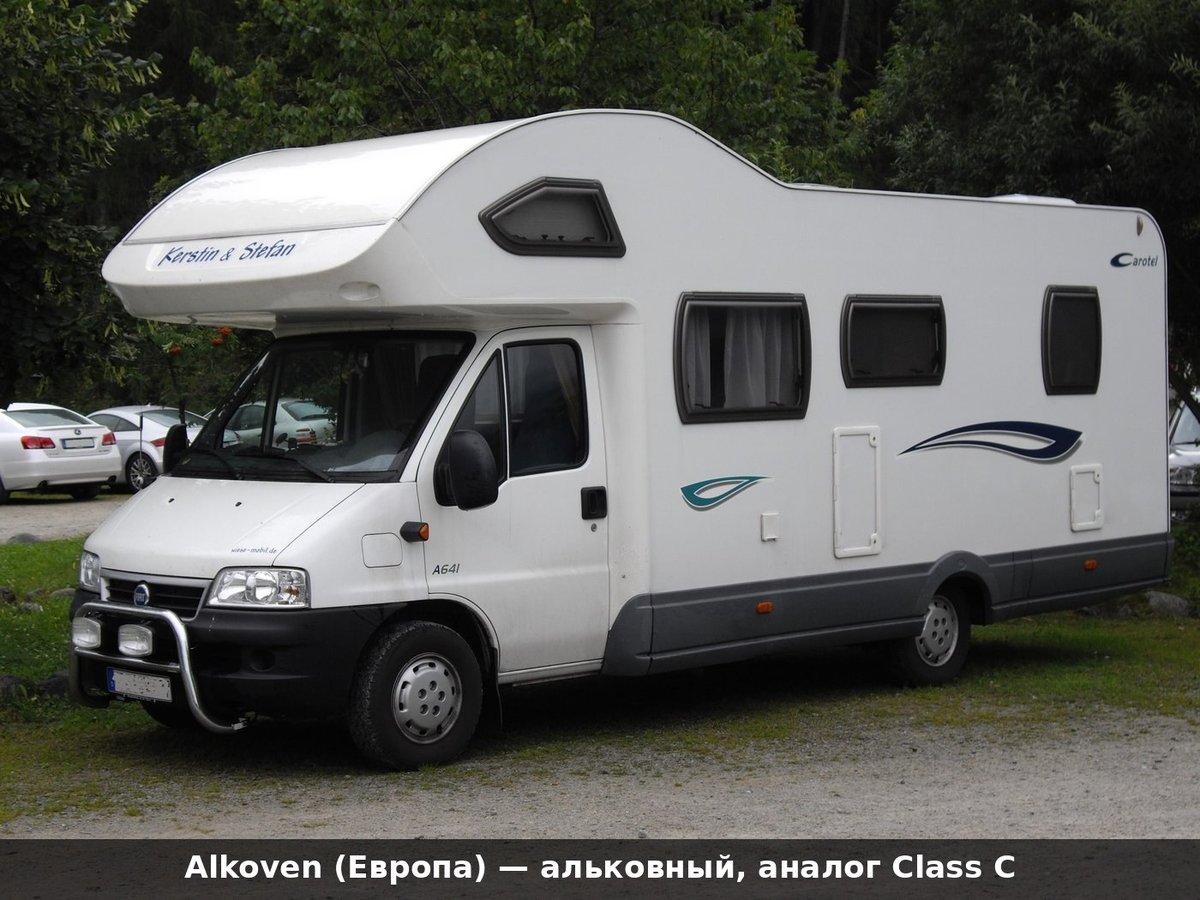
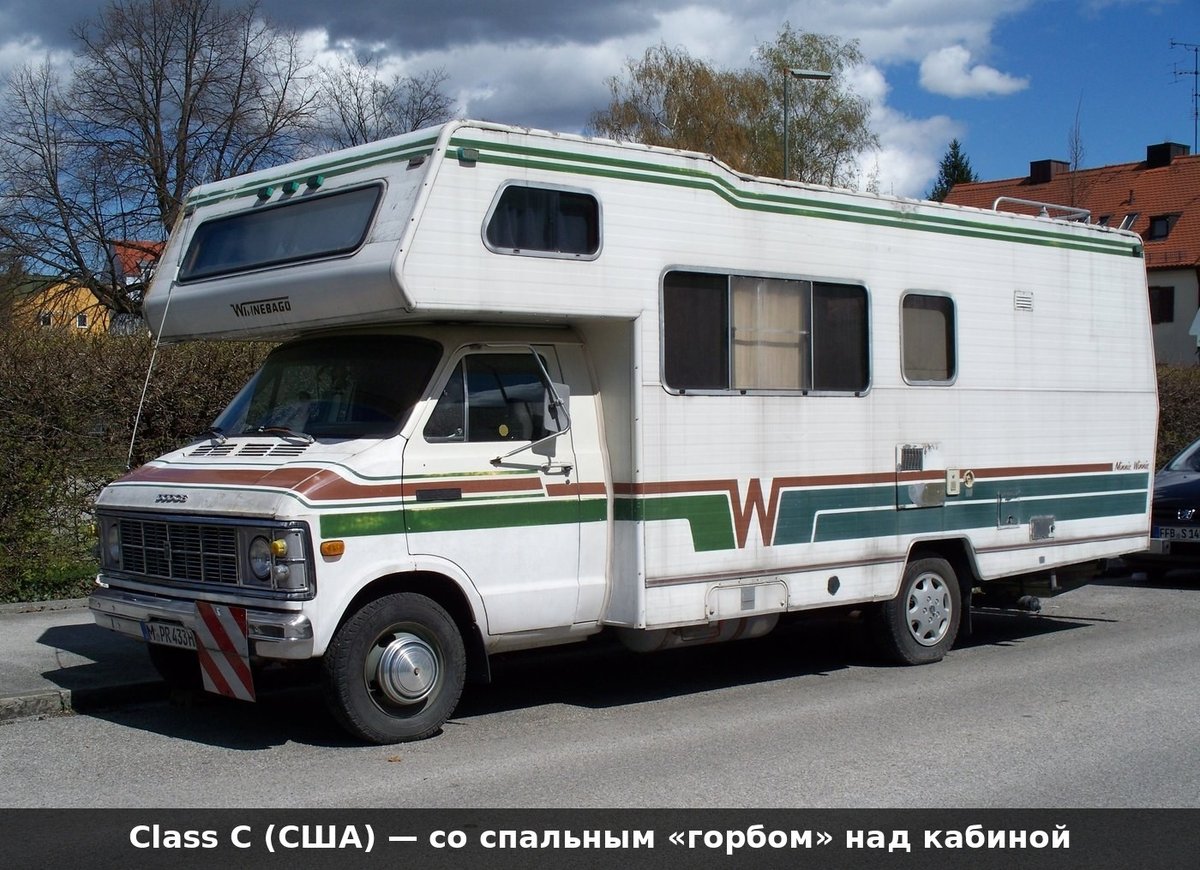
Class C — with a sleeping "hump" over the cab. Built on a cutaway chassis (Ford E-450, Chevy 4500, Mercedes Sprinter 3500/4500) — a chassis that comes with a finished cab and engine bay but without the main body, which is then completed by a coachbuilder. The signature feature is the sleeping "hump" over the cab (alcove, cab-over bunk). Length 6–10 meters, 4–8 sleeping berths. This is the most "family" format and the most common rental class in the US.
Super C — a hybrid format: externally it's the same C with a sleeping hump, but built on a medium-duty truck (Ford F-550/F-600, Freightliner S2RV, International CV). Almost always diesel, usually with serious torque reserves. The idea is to combine the spaciousness of a Class A with the off-road capability and pulling power of a truck. Length 10–14 meters, brands Renegade, Dynamax, Entegra. You'll rarely see such vehicles in Europe, and even less here.
Trailers in the US:
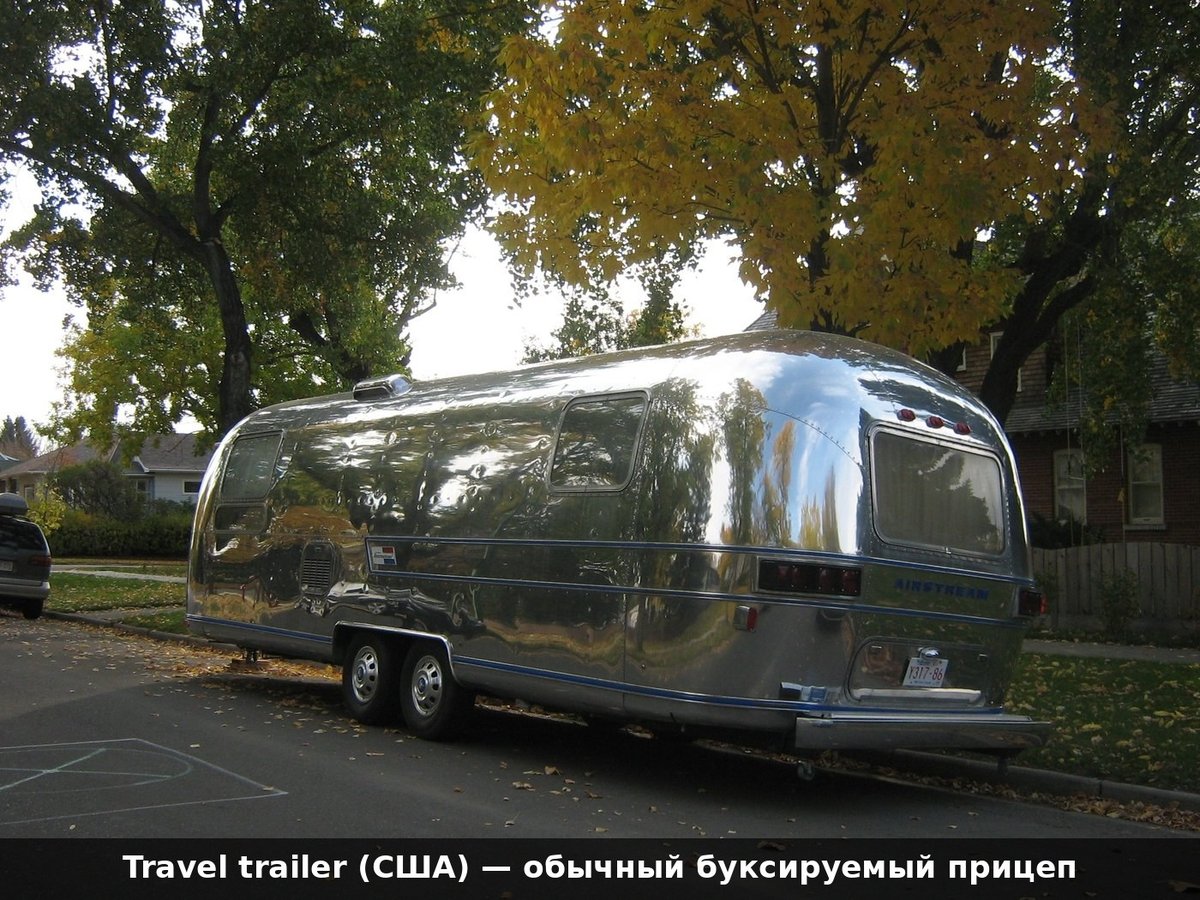
Travel trailer — an ordinary ball-hitch trailer, "bumper-pull." Length 4–10 meters. The most popular category. The genre's icon is the aluminum Airstream.
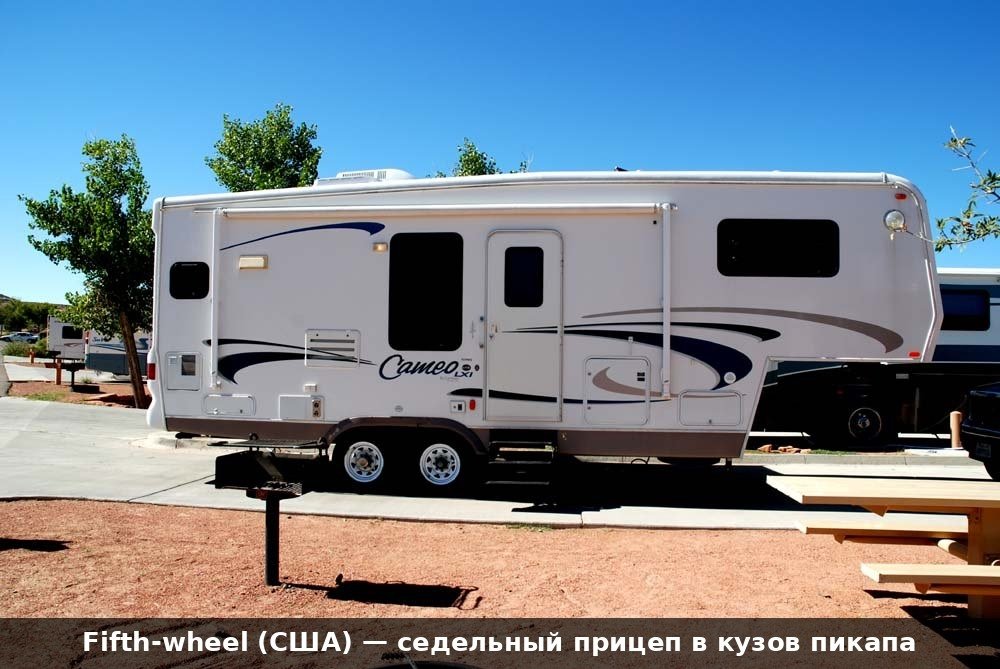
Fifth-wheel trailer — a fifth-wheel trailer: it hitches not to a tow ball but to a special plate in the bed of a pickup (the same setup as on long-haul tractor-trailers). The front part is raised and overhangs the truck bed. Length can reach 14 meters and more — it's considered the "luxury" segment among trailers.
Toy hauler — a trailer or fifth-wheel with a rear garage and a fold-down ramp for ATVs, motorcycles, snowmobiles. When the gear is unloaded, the garage doubles as an extra room.
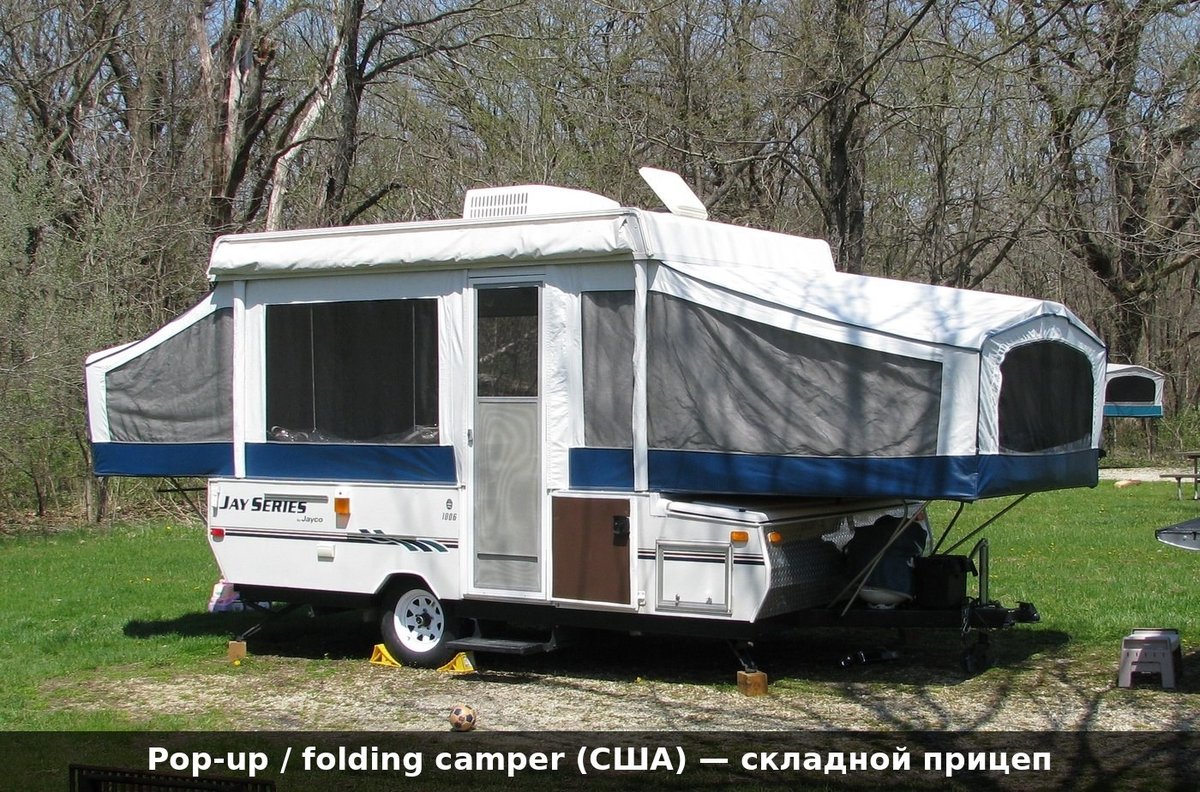
Pop-up / folding camper — a folding trailer: a rigid base, with the upper part on a tent canopy that unfolds at the campsite. Light, can be towed by an ordinary passenger car. The format is familiar to Soviet auto-tourists from the "Skif" trailers.
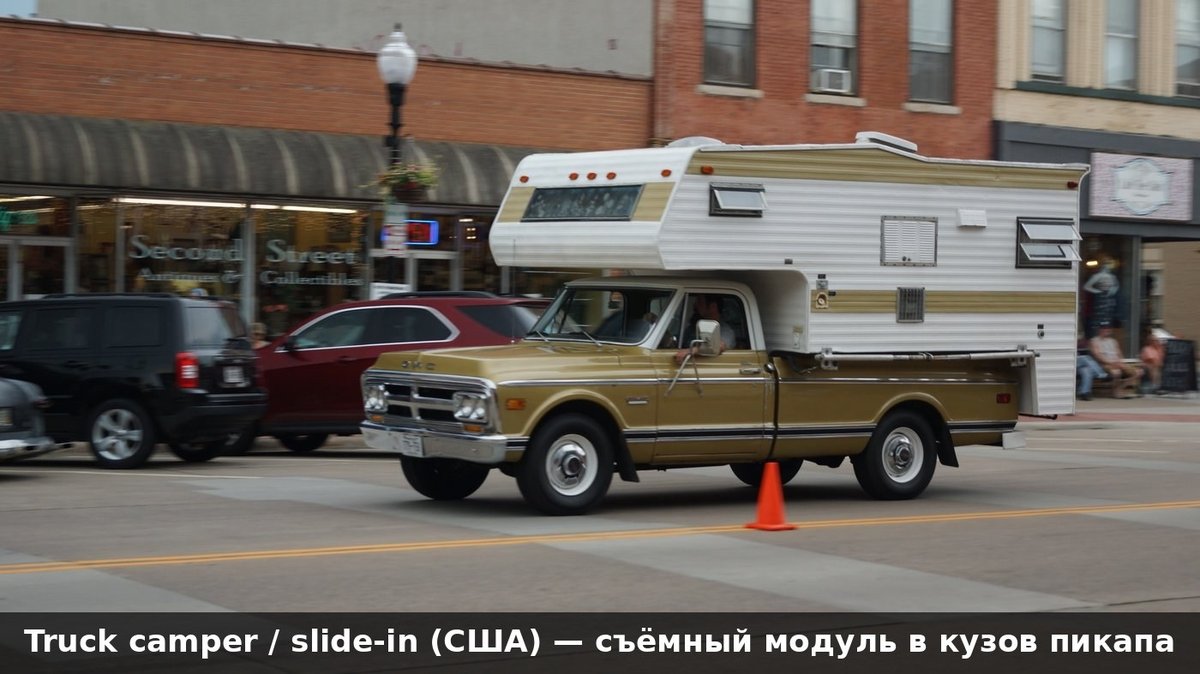
Truck camper (slide-in) — a removable living module that slides into a pickup bed and, when needed, dismounts onto four jacks. Technically it's neither a trailer nor a motorhome — a separate hybrid.
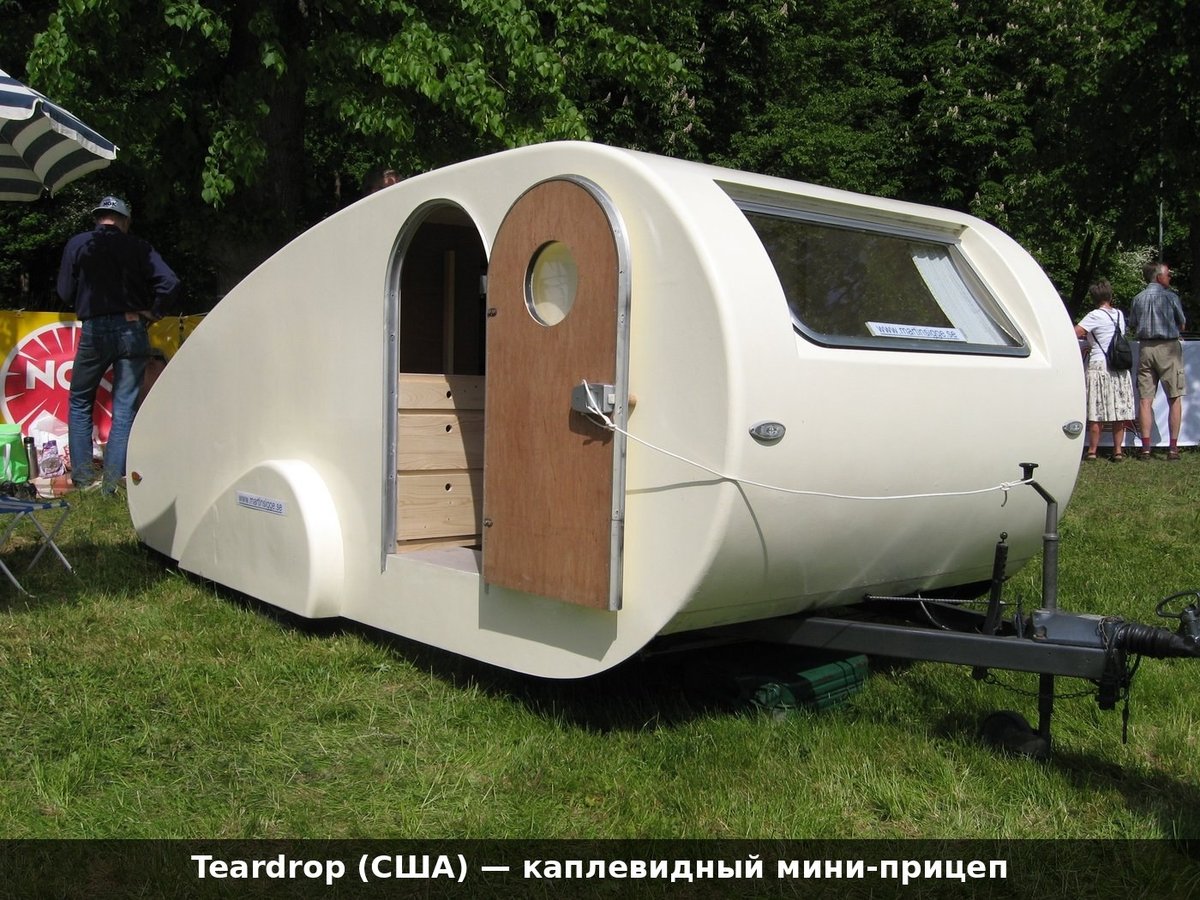
Teardrop — a mini-trailer with a teardrop shape. 2–3 sleeping berths, usually with a fold-down "kitchen" at the rear. They first appeared in DIY magazines in the 1930s and went through a renaissance in the late 1990s.
WHY AMERICAN MOTORHOMES ARE SO BIG
This is the point where the usual question comes up: why do Americans drive these buses at all? Why is nothing similar mass-produced in Europe or here?
The main reason is licensing. In the US, a standard non-commercial driver's license lets you drive any personal vehicle with a gross weight up to 26,000 pounds — about 11.8 tons. The minimum age for that license in most states is 16. So a teenager who has just passed the test has every right to take the wheel of a 12-meter Class A — no extra categories, medical exams, or driving experience required. Which means an American manufacturer can build for the entire market without second-guessing: a family of four can all drive the Class A regardless of who happens to be behind the wheel.
In Europe, things are arranged the other way around. Category B is capped at a gross weight of 3,500 kg and is available from age 18. Anything heavier is already category C1 (up to 7,500 kg) or C (over 7,500 kg). C1 opens at 18, but only after obtaining B, plus a mandatory medical exam and a retake every five years. C — only from 21, with the same medical checks and retake. So European motorhome manufacturers bend over backwards to fit a vehicle into those 3,500 kg fully loaded — otherwise they lose nearly all potential buyers. Because of this, European alcove, semi-integrated, and integrated motorhomes come with thin composite walls, weight-conscious tanks, and meticulous axle weight distribution. Manufacturers have even managed to get the EU to ease the rules: from 2030, category B will be able to cover motorhomes up to 4,250 kg (after a short additional course) — but that's still many times less than the American 11.8 tons.
In Russia, the rules largely mirror the European ones: category B — up to 3,500 kg from age 18, category C — over 3,500 kg from age 21, with a medical exam. So mass-market motorhomes here are alcoves, semi-integrateds, and kastenwagens built on the Fiat Ducato, Mercedes Sprinter, Ford Transit, or GAZelle Next, just like in Germany and France. Class A in its pure form is rare here mainly for this reason, not because of taste.
A few more factors layer on top of that. European roads and parking lots are sized for smaller vehicles: a medieval lane or an underground garage doesn't get along well with a 12-meter bus. Many European countries have toll roads and vignettes tied to weight — the heavier you are, the more you pay. Gasoline in Europe has historically been 2–3 times more expensive than in the US, and a large motorhome drinks a lot. In America it's the opposite: wide highways, cheap fuel, a developed network of campgrounds with 50-amp hookups, and no weight obstacles for the private owner. So the Class A is a market-natural form there, while in Europe and here there's simply no one to build it for.
THE EUROPEAN SYSTEM: FOUR TYPES OF WOHNMOBIL AND WOHNWAGEN
In Europe, the picture is set up differently. Here there is both a legal layer (regulation EU 2018/858, vehicle category M1 with a body code SA "motor caravan," plus the industry standards EN 1645 for caravan trailers and EN 1646 for motorhomes) and an established marketing vocabulary. In the latter there are four body types, and each has names in several languages at once. The German terms have effectively become pan-European.
Alcove — that very "hump over the cab." In Germany — Alkoven, in France — capucine, in Italy — mansardato. Essentially a full twin of the American Class C: a stock cab (Fiat Ducato, Citroën Jumper) plus a separate body with a sleeping canopy. The most "family" format: a berth above the cab means two extra bunks for free.
Teilintegriert / profilé — semi-integrated (low-profile). Here the original chassis cab is kept (the same Ducato, Sprinter), with a low "box-style" living module on top, without a sleeping hump. Nothing is lost inside — the bed is usually placed at the rear, or a drop-down bed is used that lowers from the ceiling at night. On the outside the vehicle ends up noticeably lower and more aerodynamic. This is the most popular class in Germany and France. Brands — Knaus Sun TI, Adria Matrix, Hymer Tramp.
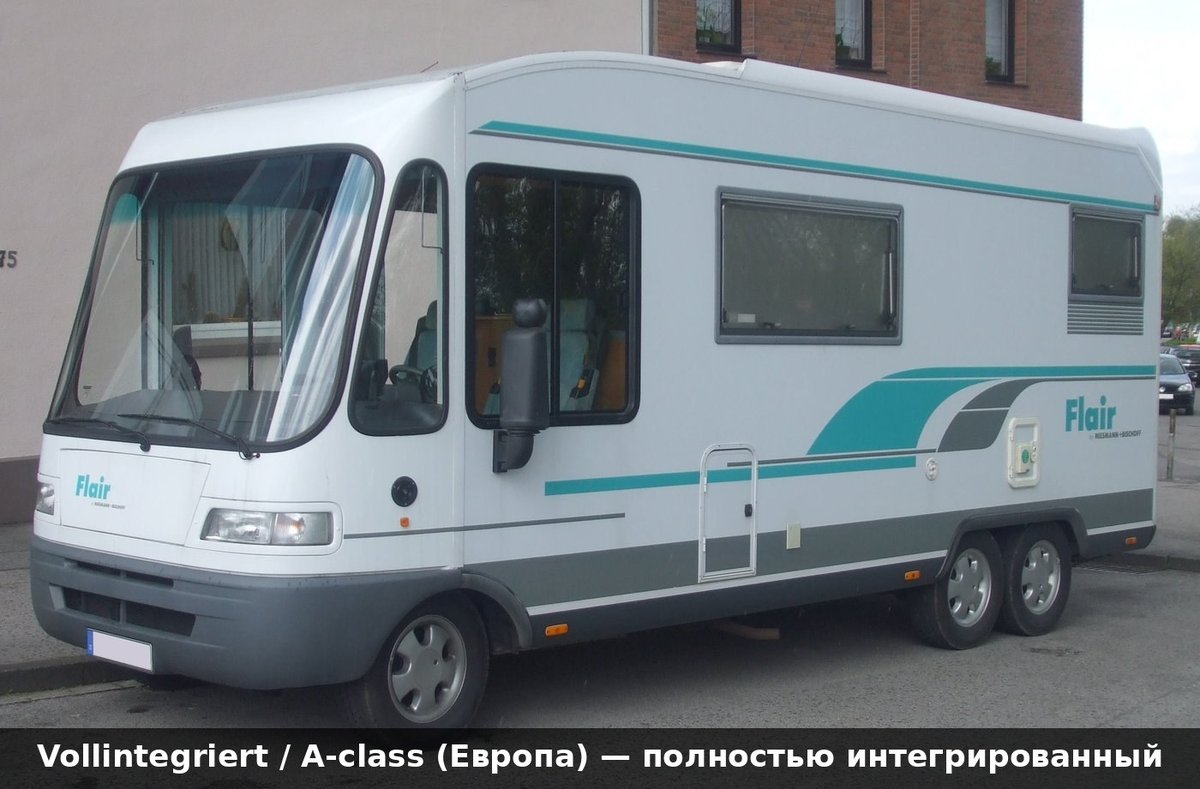
Vollintegriert / intégral — integrated (A-class). Here only the bare chassis with engine and pedals (in German, Windlauf) is kept from the original vehicle, while the entire superstructure, including the front end with a panoramic windshield and the brand's own face, is built from scratch. That's what premium-segment vehicles look like: Hymer B-Class, Concorde, Morelo, Niesmann+Bischoff, Frankia. In the US these would be called Class A in pure form, but the European intégral is usually more compact than the American "bus."
Kastenwagen / fourgon aménagé — kastenwagen (camper van). Literally "box van": the living module isn't bolted on the outside but assembled inside a ready-made all-metal van, most often a Fiat Ducato, Ford Transit, Mercedes Sprinter, VW Crafter, or Transporter. No side add-ons, the shape of the vehicle doesn't change — so it's maneuverable, fits into underground parking without trouble, and on the outside is almost indistinguishable from an ordinary cargo van. In Europe, since 2015 it has been the fastest-growing segment. The direct American counterpart is Class B.
Trailers, European-style:
Wohnwagen / caravane / touring caravan — a regular towed caravan, ball hitch. The direct counterpart of the American travel trailer; standard EN 1645.
Faltcaravan / caravane pliante — a folding trailer, the counterpart of the American pop-up.
The fifth-wheel is rare in Europe: pickup trucks aren't common here, and hitch loads are regulated differently.
AND WHAT ABOUT RUSSIA?
In short — there's no settled classification here, and the terms in catalogs are used inconsistently. Legally, GOST R 52051-2003 (an adaptation of the UNECE rules) contains only one concept — "avtomobil-dom" (motor-home), described as a "special-purpose category M1 vehicle" with sleeping berths, a table, kitchen equipment, and luggage space. From the legal standpoint, an alcove, a kastenwagen, and an integrated are all the same category. For trailers, regulatory documents use the term "pritsep-dacha" (cottage trailer), categories O1/O2.
In everyday speech and in the catalogs of Russian sellers, words are borrowed from wherever, mostly from German:
— Avtodom — a general word for any self-propelled house on wheels (a calque from Wohnmobil).
— "House on wheels" — a colloquial umbrella term for everything at once, including trailers.
— Kemper — a loan from English. For some dealers "kemper" means a panel van (i.e., a kastenwagen), for others it's a synonym for "avtodom" in general.
— Alkovny (alcove-type) — a direct calque from Alkoven. The same thing as Class C.
— Semi-integrated (sometimes "poluintegralny") — a calque from Teilintegriert.
— Integrated or fully-integrated — a calque from Vollintegriert.
— Kastenwagen — a transliteration. Sometimes called a "living van" or a "van-camper."
— Caravan, residential trailer, pritsep-dacha — these all refer to the same towed trailer, the terms compete with each other.
— Pritsep-palatka (trailer-tent) — a folding trailer, the European Faltcaravan.
— Trailer — an English calque; depending on the author it can mean either a travel trailer or any large trailer in general.
— Pickup-camper, removable module — truck camper. There's no single established word.
— Teardrop trailer, "teardrop" — teardrop; almost exclusively an enthusiast term.
Plus a distinctly Russian niche for which there's no Western equivalent: ekspeditsionniki, i.e. living modules on KAMAZ, Ural, Sadko, and the like. They don't fit into Western categories and are built here for entirely different tasks — places where Western vehicles simply can't drive. And in any case, they are all built here strictly to order, not in series.
In the end, no unified classification has really taken root in Russia: neither official nor even slang. We mostly rely on the German scheme and roughly understand the American one. So if in a conversation with different people you hear "kemper," "avtodom," "house on wheels," "alkovnik," "caravan" — don't be surprised that they may be talking about completely different vehicles.